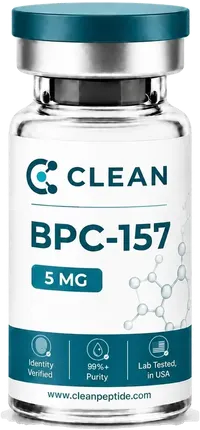
The “Wolverine stack” is the research-market name for BPC-157 and TB-500 used together. BPC-157 is a 15-residue fragment of a gastric juice protein; TB-500 is the acetylated seven-residue actin-binding fragment of thymosin beta-4. Each has its own preclinical literature. Only one controlled study has tested the two together, and it found no added benefit from combining them.
What is the Wolverine stack?
The nickname, taken from the comic-book character who heals fast, is applied to the pairing of two peptides that are each studied in tissue-repair models. “Stack” usually means the two bought as separate vials; the same pair pre-mixed in one vial is sold as the Wolverine peptide blend. The name is used loosely: FDA’s July 2026 briefing documents sites marketing a “BPC-157 and TB-500 Wolverine protocol”, and also quotes one clinic calling BPC-157 alone the “wolverine compound”.
The two peptides in the stack
| BPC-157 | TB-500 | |
|---|---|---|
| What it is | Synthetic pentadecapeptide; a partial sequence of a protein from human gastric juice |
N-acetylated fragment 17–23 of thymosin beta-4, its actin-binding region |
| Sequence | GEPPPGKPADDAGLV |
Ac-LKKTETQ |
| Length | 15 residues |
7 residues |
| Formula | C62H98N16O22 |
C38H68N10O14 |
| Molecular weight | 1419.5 g/mol |
889.0 g/mol |
| CAS | 137525-51-0 |
885340-08-9 |
| Origin | Sikirić group, University of Zagreb, early 1990s |
Derived from thymosin beta-4 (Goldstein lab sequenced Tβ4 in 1981) |
Identity: PubChem CIDs 9941957 and 62707662; FDA’s 2026 TB-500 briefing.
TB-500 is not thymosin beta-4
Many sites use the names interchangeably. They are different substances: thymosin beta-4 is a 43-residue protein, TB-500 a seven-residue acetylated fragment of it. FDA’s 2026 briefing says so explicitly and notes that it has found different salts and even different active molecules sold as “TB-500”. Human trials of full-length thymosin beta-4, such as eye-drop and wound-gel studies, are not evidence about TB-500.
What the research says about combining them
This is the honest part, and the short part:
- One controlled study tested the pair. In 32 rats with a repaired Achilles tendon, TB-500 alone improved load to failure and histology scores against controls, BPC-157 alone improved numerically, and the combination had better Movin scores than controls but did not confer additional benefits compared to either peptide alone. The authors describe it as exploratory. Effects of BPC-157 and TB-500 on Achilles tendon healing in rats: A histopathological and biomechanical study. Biçer O, et al. Joint Diseases and Related Surgery, 2026.
- Four people in an uncontrolled series. A retrospective chart review at one US clinic included 4 patients who had received BPC-157 with “thymosin beta-4”; the abstract does not say whether that meant TB-500. There was no control group and no validated outcome measure. Intra-Articular Injection of BPC 157 for Multiple Types of Knee Pain. Lee E, et al. Alternative Therapies in Health and Medicine, 2021.
- Nothing else. PubMed and ClinicalTrials.gov list no other study or registered trial of the two together.
The case for the pairing therefore rests on each peptide’s separate literature, not on evidence that the two work better together.
What each peptide’s own research covers
BPC-157
- Achilles tendon healing in rats: higher load to failure and stiffness than saline. Staresinic M, et al., 2003.
- Tendon fibroblasts: faster outgrowth, survival and migration through FAK–paxillin signalling. Chang CH, et al., 2011.
- Angiogenesis via VEGFR2–Akt–eNOS in endothelial cells and ischaemic rat limbs. Hsieh MJ, et al., 2017.
- Pharmacokinetics in rats and dogs: elimination half-life of the intact peptide under 30 minutes. He L, et al., 2022.
- Systematic review: 36 musculoskeletal studies, 35 preclinical and 1 clinical. Vasireddi N, et al., 2025.
TB-500 and thymosin beta-4
- Identification of Ac-LKKTETQ in a TB-500 product by mass spectrometry. Esposito S, et al., 2012.
- The LKKTETQ actin-binding motif matched full-length Tβ4 in endothelial migration and sprouting assays. Philp D, et al., 2003.
- TB-500 metabolism in rats; only the metabolite Ac-LKKTE showed wound-healing activity in a fibroblast assay. Rahaman KA, et al., 2024.
- Products sold online as TB500 did not consistently contain what they described. Delcourt V, et al., 2023.
Regulatory status and safety reports
Neither peptide is an approved drug. FDA placed both in its compounding safety-risk category in September 2023; both are now listed there as nominated-but-withdrawn, and at its July 2026 advisory meeting FDA proposed not adding either to the 503A bulks list (press reports say the committee voted 8–6 the other way; the vote is not binding). FDA’s briefing also summarises an adverse-event report involving a BPC-157 + TB-500 product labelled for research: skin and gum darkening that came back when the product was resumed. WADA’s 2026 Prohibited List names BPC-157 (S0) and TB-500 (S2.3). FDA compounding safety-risk list; FDA PCAC briefing on BPC-157, July 2026; WADA 2026 Prohibited List.
Blend or separate vials?
For research use the trade-off is control versus convenience. Separate vials let each peptide be used, documented and varied on its own. A pre-mixed blend fixes the ratio, so what matters is a certificate that measures each peptide separately. Clean Peptide’s blend certificates do: the current lots are below.
| Size | Lot | Laboratory | Analysed | HPLC purity | Measured content | Identity |
|---|---|---|---|---|---|---|
| 10mg | ILS Laboratories | 18 Sep 2026 | 99.26% | 10.49mg (BPC-157 5.25mg + TB-500 5.25mg) | Confirmed | |
| 20mg | ILS Laboratories | 18 Sep 2026 | 99.76% | 20.9mg (BPC-157 10.45mg + TB-500 10.45mg) | Confirmed |
Transcribed from the certificate issued for each size on sale today. The certificate names the material as BPC-157 / TB-500. Open the BPC-157 / TB-500 Blend certificates Every BPC-157 / TB-500 Blend COA, lot by lot
The single peptides each carry their own ILS Laboratories certificate too: BPC-157 and TB-500. Our longer comparison of blends vs single peptides covers the trade-offs in more detail, and TB-500 vs BPC-157 compares the two molecules.