GHK-Cu vs AHK-Cu: What’s the Difference?
GHK-Cu and AHK-Cu are both copper(II) complexes of a three-residue peptide, and their peptides differ at one position: glycine in GHK, alanine in AHK. Histidine and lysine, which hold the copper, are the same in both.
GHK-Cu (copper tripeptide-1) is the copper complex of glycyl-histidyl-lysine, a tripeptide found in human plasma and studied since 1973. PubMed lists more than 180 records on it.
AHK-Cu is a synthetic analogue, alanyl-histidyl-lysine with copper. PubMed lists one primary study of it, from 2007, and no registry gives the copper complex a confirmed identity.
In short: near-identical chemistry, very different evidence. Clean Peptide stocks GHK-Cu, not AHK-Cu.
GHK-Cu vs AHK-Cu at a Glance
Both are 1:1 copper(II) complexes of a tripeptide ending His-Lys. GHK-Cu is C14H22CuN6O4, 401.91 g/mol (FDA GSRS). AHK-Cu, with one extra CH2 from the alanine, is about 415.9 g/mol by calculation; no registry lists the complex.
| Comparison | GHK-Cu | AHK-Cu |
|---|---|---|
| Peptide length | 3 amino acids + Cu(II) | 3 amino acids + Cu(II) |
| Molecular weight | 401.91 g/mol | About 415.9 g/mol (calculated) |
| Sequence | GHK · Cu²⁺ | AHK · Cu²⁺ |
| Molecular relationship | Copper complex of plasma tripeptide GHK | Synthetic Ala-1 analogue of GHK-Cu |
| Main research focus | Copper transport, collagen and gene-expression research | Hair-follicle and dermal papilla cell culture |
| Research evidence | Decades of cell and animal work; small topical human trials | One primary study (ex vivo and in vitro, 2007) |
| FDA-approved drug component | No | No |
What are GHK-Cu and AHK-Cu
3 AA
GHK-Cu
Glycyl-L-histidyl-L-lysine bound to copper(II), first described in human serum by Loren Pickart.
Research areas
Copper uptake • Collagen synthesis • Wound models • Gene-expression studies
Cu(II) is held by the N-terminal amine, the first backbone amide nitrogen and the histidine imidazole. Isothermal titration calorimetry measured a conditional dissociation constant of about 7 × 10⁻¹⁴ M at pH 7.4 (Trapaidze et al., 2012).
Explore GHK-Cu3 AA
AHK-Cu
L-alanyl-L-histidyl-L-lysine bound to copper(II): GHK-Cu with alanine in place of glycine.
Research areas
Hair-follicle organ culture • Dermal papilla cells • Apoptosis markers
The free peptide AHK has a registry identity (CAS 126828-32-8, FDA UNII 1AVY5QO8WR); the copper complex does not, so its formula and weight are calculated by analogy with GHK-Cu. Its copper binding is inferred from the shared Xxx-His motif; no study has measured it.
GHK-Cu: Gly-His-Lys · CuPosition 1: Gly → AlaAHK-Cu: Ala-His-Lys · Cu
Same His-Lys copper-binding end; one methyl group apart
Key Differences Between GHK-Cu and AHK-Cu
| Key differences | GHK-Cu | AHK-Cu |
|---|---|---|
| Residue 1 | Glycine: no side chain, achiral. |
Alanine: a methyl side chain, L-configuration. |
| Origin | GHK occurs naturally in human plasma; first reported in 1973. |
Synthetic; no natural source reported. |
| Registry identity | GHK-Cu: CAS 89030-95-5, FDA UNII 6BJQ43T1I9. |
Peptide AHK: CAS 126828-32-8, UNII 1AVY5QO8WR. The copper complex has no registry record; vendor CAS numbers are unverified. |
| Copper binding | Measured: three-nitrogen binding, conditional Kd about 7 × 10⁻¹⁴ M at pH 7.4. |
Not measured; inferred from the same N-terminal Xxx-His motif. |
| Published research | 180+ PubMed records: cell, animal and small topical human studies. |
One primary study (Pyo et al., 2007): hair-follicle organ culture and dermal papilla cells. |
| Cosmetic name | Copper tripeptide-1 in the EU CosIng database. |
"Copper tripeptide-3" is a vendor name only; CosIng has no such entry. |
How their research profiles differ
- GHK-Cu
- Endogenous plasma tripeptide + Cu
- Measured copper affinity
- Large preclinical literature
- AHK-Cu
- Synthetic Ala-1 analogue + Cu
- Copper binding inferred
- A single 2007 study
GHK-Cu vs AHK-Cu: Which Is Better?
No study has compared them. What can be said is that GHK-Cu is the characterised molecule: its copper binding has been measured and it has been studied in cells, animals and small human trials, while AHK-Cu rests on one 2007 cell and organ-culture study.
A 2026 evidence-mapping review describes AHK-Cu as sharing GHK-Cu's copper-binding motif on a thin, poorly characterised evidence base.
Does the work need the characterised reference molecule, GHK-Cu, or is it specifically about what the alanine substitution changes?
Can GHK-Cu and AHK-Cu Be Studied Together?
As separate groups, yes: comparing the two is the direct way to see what replacing glycine with alanine does to copper binding or to a cell readout, and no published study has done it yet.
Because both carry the same copper-binding end, mixing them in one condition would make their effects hard to tell apart.
There Isn’t One Universal “Winner”
GHK-Cu
The characterised copper tripeptide
Gly-His-Lys • 180+ PubMed records
AHK-Cu
A lightly studied analogue
Ala-His-Lys • one primary study
Compare the Research. Verify the Material.
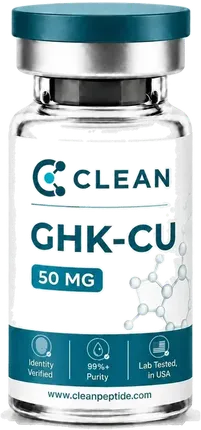
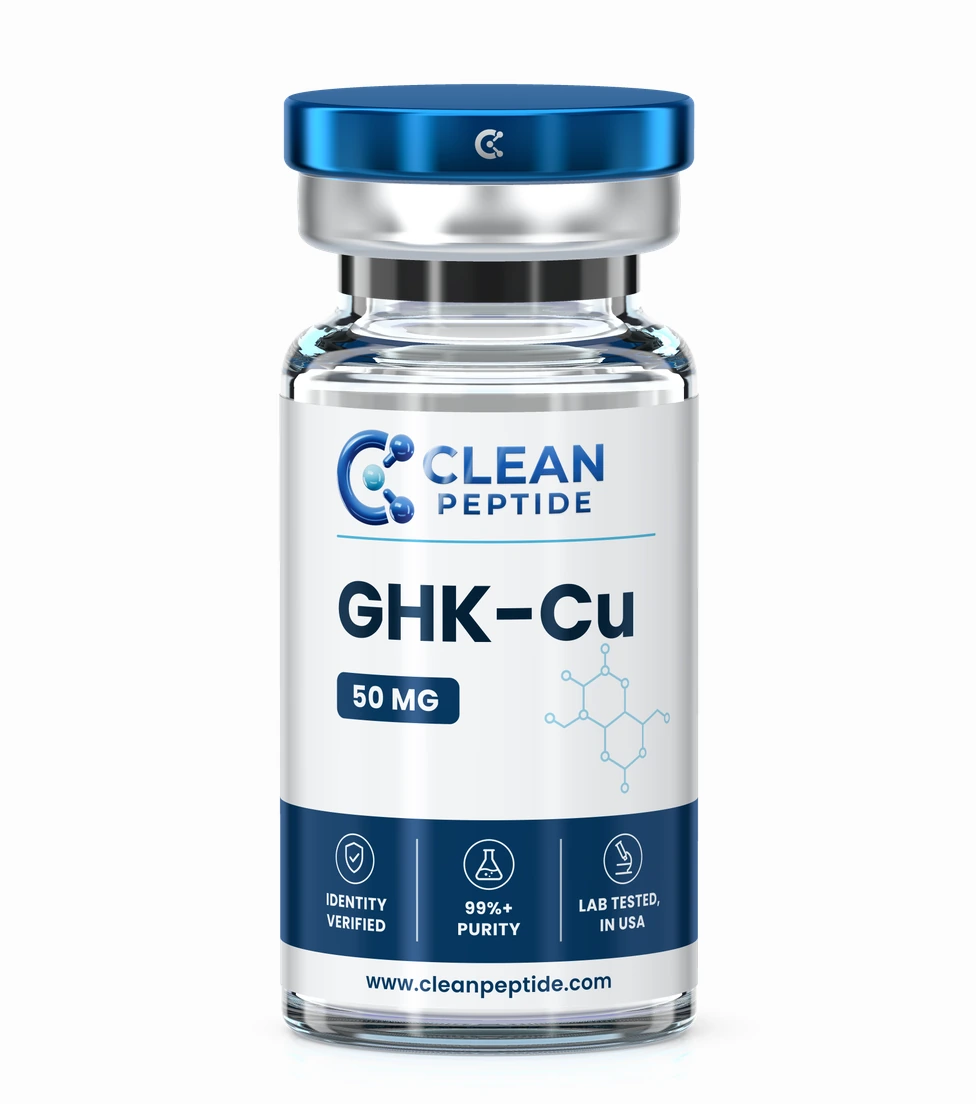
Clean Peptide stocks GHK-Cu in 50 mg and 100 mg vials, each size with its own lot certificate showing HPLC purity, measured content and identity on the product page.
We do not stock AHK-Cu.
 Research use only
 Identity
verified Purity
verified
Question
Frequently Asked
What is the difference between GHK-Cu and AHK-Cu?
One amino acid. GHK-Cu is the copper complex of glycyl-histidyl-lysine; AHK-Cu has alanine in place of glycine. The histidine and lysine that hold the copper are the same.
Is AHK-Cu the same as copper tripeptide-3?
Vendors use that name, but the EU cosmetic-ingredient database has no entry called copper tripeptide-3, and its "tripeptide-3" is a different peptide. GHK-Cu is listed there as copper tripeptide-1.
How much research is there on AHK-Cu?
One primary study on PubMed (Pyo et al., 2007), which used cultured human hair follicles and dermal papilla cells. GHK-Cu has more than 180 PubMed records.
What is the molecular weight of AHK-Cu?
About 415.9 g/mol for the 1:1 copper complex, calculated from the peptide AHK (354.41 g/mol). No registry lists the complex itself. GHK-Cu is 401.91 g/mol.
Are GHK-Cu or AHK-Cu FDA-approved?
Neither is an approved drug. FDA lists GHK-Cu for non-injectable routes in its 503A category 1 (under evaluation); AHK-Cu does not appear on FDA's compounding lists.
Does Clean Peptide sell AHK-Cu?
No. We stock GHK-Cu in 50 mg and 100 mg, each lot with its own certificate, and KLOW, a blend that contains GHK-Cu.
Research Peptides. Documented by Batch.
Every size in the catalogue ships against the certificate issued for its own lot.
For laboratory research use only. Not for human or veterinary use.
References
Identity data come from the FDA substance registry (GSRS), PubChem and CAS Common Chemistry. Study descriptions follow the PubMed abstracts.
- Pickart L, et al. Tripeptide in human serum which prolongs survival of normal liver cells and stimulates growth in neoplastic liver Nature New Biology, 1973. The discovery of GHK.
- Pickart L, et al. Growth-modulating plasma tripeptide may function by facilitating copper uptake into cells Nature, 1980. GHK and copper.
- Maquart FX, et al. Stimulation of collagen synthesis in fibroblast cultures by the tripeptide-copper complex glycyl-L-histidyl-L-lysine-Cu2+ FEBS Letters, 1988.
- Trapaidze A, et al. Thermodynamic study of Cu2+ binding to the DAHK and GHK peptides by isothermal titration calorimetry (ITC) with the weaker competitor glycine Journal of Biological Inorganic Chemistry, 2012. Measured copper affinity of GHK.
- Gonzalez P, et al. N-Terminal Cu-Binding Motifs (Xxx-Zzz-His, Xxx-His) and Their Derivatives: Chemistry, Biology and Medicinal Applications Chemistry, 2018. The Xxx-His motif both peptides share.
- Pyo HK, et al. The effect of tripeptide-copper complex on human hair growth in vitro Archives of Pharmacal Research, 2007. The one primary study of AHK-Cu.
- Mateescu DM, et al. GHK-Cu as a Bioactive Metallopeptide and Drug-Delivery Cargo: Coordination Chemistry, Formulation Science, Therapeutic Evidence, and a Translational Roadmap Pharmaceutics, 2026. Places AHK-Cu beside GHK-Cu.