Tesamorelin vs Sermorelin: What’s the Difference?
Tesamorelin and sermorelin are both synthetic versions of growth hormone-releasing hormone (GHRH), and both act on the same receptor, the GHRH receptor of the pituitary. They differ in how much of the hormone they keep and how they are protected.
Sermorelin is the first 29 residues of human GHRH with a C-terminal amide and no other change, the shortest fragment with the hormone's full activity. It was sold in the US as Geref until 2008.
Tesamorelin keeps all 44 residues and adds a trans-3-hexenoyl group to the first tyrosine, which shields it from the enzyme DPP-IV. It is FDA-approved as Egrifta.
In short: same receptor, different length and stability. Ipamorelin, often named alongside them, works through a different receptor altogether.
Tesamorelin vs Sermorelin at a Glance
Both act on the GHRH receptor. Tesamorelin is the full 44-residue hormone with an N-terminal hexenoyl group (C221H366N72O67S, 5,135.9 Da); sermorelin is the 29-residue N-terminal fragment with a C-terminal amide (C149H246N44O42S, 3,357.9 g/mol). Tesamorelin is FDA-approved; sermorelin's approvals were withdrawn in 2009.
| Comparison | Tesamorelin | Sermorelin |
|---|---|---|
| Peptide length | 44 amino acids | 29 amino acids |
| Molecular weight | 5,135.9 Da | 3,357.9 g/mol |
| Sequence | (trans-3-hexenoyl)-YADAIFTNSYRKVLGQLSARKLLQDIMSRQQGESNQERGARARL-NH2 | YADAIFTNSYRKVLGQLSARKLLQDIMSR-NH2 |
| Molecular relationship | Full-length GHRH(1-44), N-acylated | GHRH(1-29) amide |
| Main research focus | GHRH receptor signalling | GHRH receptor signalling |
| Research evidence | Phase 3 trials; FDA-approved | Clinical studies 1985–1997; formerly FDA-approved |
| FDA-approved drug component | Yes (Egrifta SV, Egrifta WR) | Formerly (Geref, withdrawn 2009) |
What are Tesamorelin and Sermorelin
44 AA
Tesamorelin
All 44 residues of human GHRH with a trans-3-hexenoyl group on Tyr1 and a C-terminal amide, developed by Theratechnologies.
Research areas
GHRHR • GH pulsatility • IGF-1 • Visceral and liver fat in HIV
The hexenoyl group sits where DPP-IV would cut native GHRH, and the peptide was resistant to it in plasma (Ferdinandi et al., 2007). Its label gives a mean elimination half-life of 8–11 minutes after subcutaneous injection.
Explore Tesamorelin29 AA
Sermorelin
The first 29 residues of human GHRH with a C-terminal arginine amide, all natural L-amino acids.
Research areas
GHRHR • GH stimulation testing • Paediatric GH deficiency • Ageing studies
In rat pituitary cells it kept full intrinsic activity at about half the potency of full-length GHRH (Ling et al., 1984). In human plasma DPP-IV cuts it at Ala2–Asp3, and its disappearance half-time during IV infusion was about 4 minutes (Soule et al., 1994).
Human GHRH — 44 AAResidues 1–29 carry the activitySermorelin — 29 AA
Sermorelin = GHRH(1–29)-NH₂; tesamorelin = hexenoyl-GHRH(1–44)-NH₂
Key Differences Between Tesamorelin and Sermorelin
| Key differences | Tesamorelin | Sermorelin |
|---|---|---|
| Length | All 44 residues of human GHRH. |
Residues 1–29 only. |
| Modifications | trans-3-Hexenoyl group on Tyr1; C-terminal amide. |
C-terminal amide only; no unnatural residues. |
| DPP-IV stability | Resistant to dipeptidyl peptidase-IV in plasma. |
Cut by DPP-IV at Ala2–Asp3 in human plasma. |
| Reported half-life | 8–11 minutes after subcutaneous injection (FDA label). |
About 4 minutes during constant IV infusion (Soule et al., 1994); a different route and design. |
| US approvals | Egrifta, approved November 2010, for excess abdominal fat in adults with HIV and lipodystrophy. |
Geref, approved 1990 (diagnostic) and 1997 (paediatric GH deficiency); discontinued 2008, approvals withdrawn 2009, not for safety or effectiveness reasons (FDA, 2013). |
| Where ipamorelin fits | Different receptor: ipamorelin is a 5-residue ghrelin-receptor (GHS-R1a) agonist, not a GHRH analogue. |
Same: sermorelin and ipamorelin reach GH release through two separate receptors. |
How their research profiles differ
- Tesamorelin
- 44-AA modified GHRH
- GHRH receptor, DPP-IV resistant
- Approved drug with a phase 3 record
- Sermorelin
- 29-AA GHRH fragment
- GHRH receptor, DPP-IV sensitive
- Older clinical literature, 1985–1997
Tesamorelin vs Sermorelin: Which Is Better?
They have never been compared head to head, and their approved uses never overlapped: sermorelin was a pituitary diagnostic and a treatment for children with GH deficiency, tesamorelin is approved for abdominal fat in HIV lipodystrophy.
What can be compared is the molecule. Tesamorelin is longer and protected at the end DPP-IV attacks; sermorelin is the minimal active fragment with no protection. Both act on the same receptor.
Does the model need the minimal native GHRH fragment, or a full-length GHRH analogue built to resist DPP-IV?
Can Tesamorelin and Sermorelin Be Studied Together?
They can be compared as separate groups when the aim is to see what length and N-terminal protection change at the same receptor.
Giving both in one condition is a different matter: both act on the GHRH receptor, so their effects would overlap. A GHRH analogue paired with a ghrelin-receptor agonist such as ipamorelin is a different design, because the two act through separate pathways.
There Isn’t One Universal “Winner”
Tesamorelin
Full-length, DPP-IV-resistant GHRH
44 AA • GHRHR • FDA-approved
Sermorelin
Minimal active GHRH fragment
29 AA • GHRHR • approval withdrawn 2009
Compare the Research. Verify the Material.
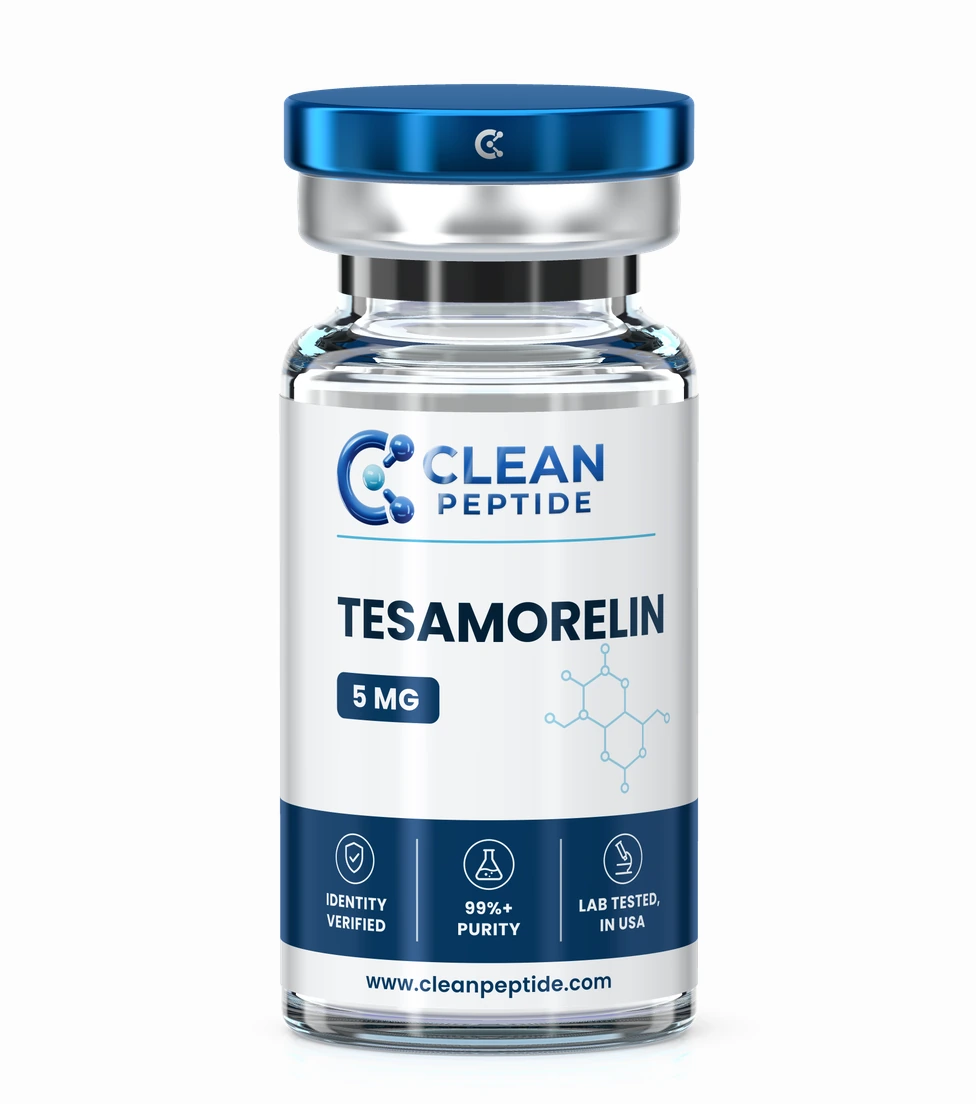
Clean Peptide stocks tesamorelin in 5 mg and 10 mg. Each size ships against its own ILS Laboratories certificate, a full QC panel with identity confirmed by HPLC retention time against a tesamorelin reference standard, plus HPLC purity, net peptide content, endotoxin, sterility, heavy metals and a fentanyl screen.
We do not stock sermorelin at the moment.


Question
Frequently Asked
What is the difference between tesamorelin and sermorelin?
Both are GHRH analogues acting on the GHRH receptor. Sermorelin is residues 1–29 of human GHRH with a C-terminal amide. Tesamorelin is the full 44 residues with a trans-3-hexenoyl group that protects it from DPP-IV.
Is sermorelin still FDA-approved?
No. Sermorelin was approved as Geref in 1990 and 1997, discontinued by EMD Serono in 2008, and its approvals were withdrawn in 2009. FDA determined in 2013 that it was not withdrawn for safety or effectiveness reasons.
Is tesamorelin FDA-approved?
Yes. It was approved in November 2010 as Egrifta (Theratechnologies) for reducing excess abdominal fat in adults with HIV and lipodystrophy.
How do tesamorelin, sermorelin and ipamorelin differ?
Tesamorelin and sermorelin are GHRH analogues that act on the GHRH receptor. Ipamorelin is a 5-residue peptide that acts on a different receptor, the ghrelin receptor (GHS-R1a).
Which lasts longer, tesamorelin or sermorelin?
Tesamorelin is built to resist DPP-IV, which cuts sermorelin quickly in human plasma. The published half-lives (8–11 minutes for tesamorelin subcutaneously, about 4 minutes for sermorelin's sequence during IV infusion) come from different routes and designs.
Does Clean Peptide sell sermorelin?
Not at the moment. We stock tesamorelin in 5 mg and 10 mg, each with an ILS Laboratories certificate.
Research Peptides. Documented by Batch.
Every size in the catalogue ships against the certificate issued for its own lot.
For laboratory research use only. Not for human or veterinary use.
References
Identity data come from the Egrifta labels, the FDA substance registry (GSRS) and PubChem; approval history from Drugs@FDA and the Federal Register. Study descriptions follow the PubMed abstracts.
- Guillemin R, et al. Growth hormone-releasing factor from a human pancreatic tumor that caused acromegaly Science, 1982. The 44-residue GHRH sequence.
- Ling N, et al. Synthesis and in vitro bioactivity of C-terminal deleted analogs of human growth hormone-releasing factor Biochemical and Biophysical Research Communications, 1984. GRF(1-29)NH2 keeps full activity.
- Frohman LA, et al. Dipeptidylpeptidase IV and trypsin-like enzymatic degradation of human growth hormone-releasing hormone in plasma Journal of Clinical Investigation, 1989. Where DPP-IV cuts.
- Soule S, et al. Incorporation of D-Ala2 in growth hormone-releasing hormone-(1-29)-NH2 increases the half-life and decreases metabolic clearance in normal men Journal of Clinical Endocrinology & Metabolism, 1994. Half-time of the 1-29 sequence.
- Prakash A, Goa KL. Sermorelin: a review of its use in the diagnosis and treatment of children with idiopathic growth hormone deficiency BioDrugs, 1999.
- Ferdinandi ES, et al. Non-clinical pharmacology and safety evaluation of TH9507, a human growth hormone-releasing factor analogue Basic & Clinical Pharmacology & Toxicology, 2007. Tesamorelin's DPP-IV resistance.
- Falutz J, et al. Metabolic effects of a growth hormone-releasing factor in patients with HIV NEJM, 2007. Tesamorelin phase 3.
- Federal Register Determination that GEREF (sermorelin acetate) injection was not withdrawn from sale for reasons of safety or effectiveness 78 FR 14095, 4 March 2013.