Certificate terms
What does “Sterility (PCR)” or “Pour Plate” mean on a COA?
Short answer
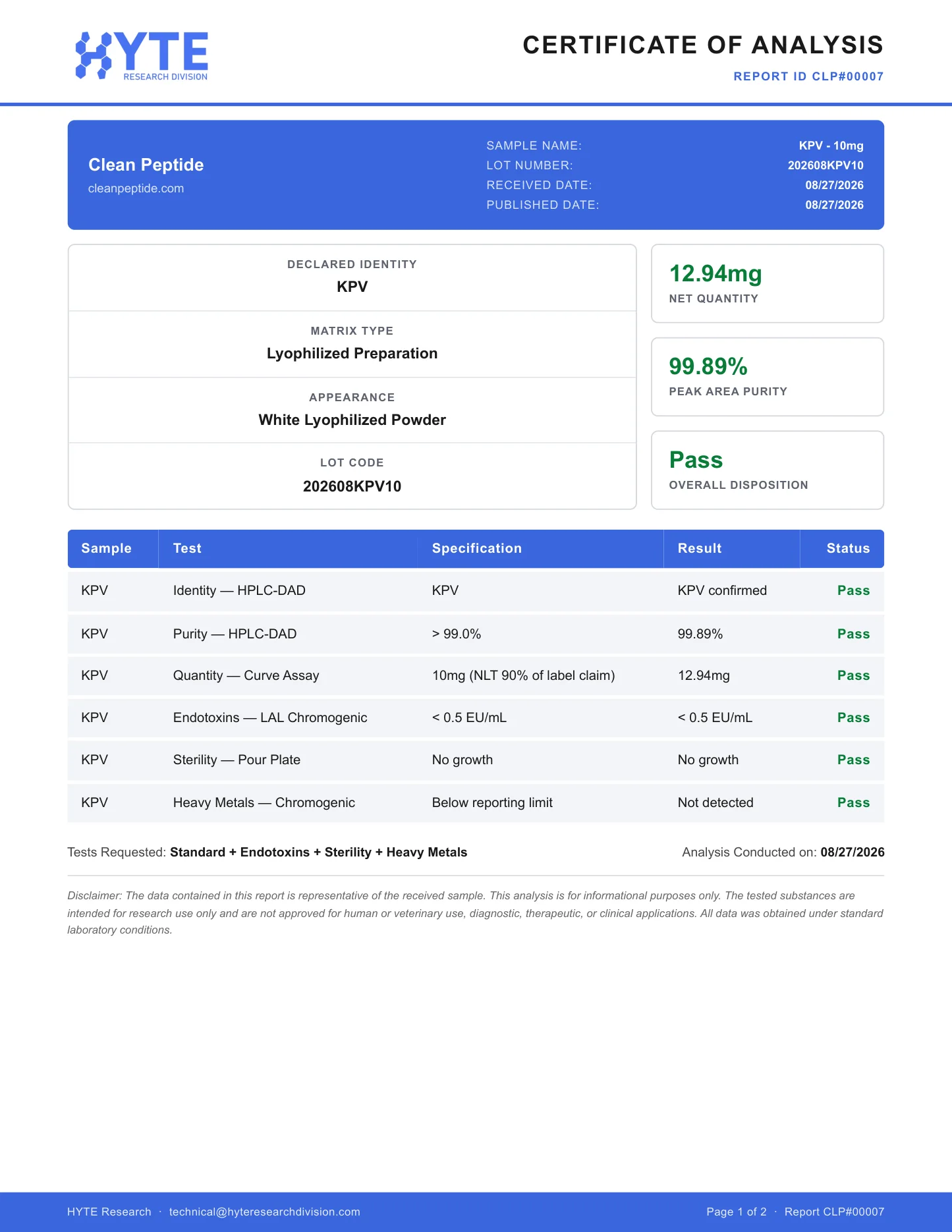
Both name the method a laboratory used for a sterility test. On Clean Peptide's certificates, ILS Laboratories lists PCR, polymerase chain reaction, on all 24 of its lots, and HYTE Research Division lists pour plate on GLP-2 Tirz 20 mg and KPV 10 mg. Every result reads no growth. Neither laboratory's certificate describes the procedure further.
Sterility methods on the current certificates
| Laboratory | Method as printed | Specification | Result | Lots |
|---|---|---|---|---|
| ILS Laboratories | PCR (polymerase chain reaction) | No Growth | No Growth | 24 lots, every ILS lot |
| HYTE Research Division | Pour Plate | No Growth | No Growth | GLP-2 Tirz 20 mg |
| HYTE Research Division | Pour Plate | No growth | No growth | KPV 10 mg (certificate) |
Read from the live lot pages on 30 October 2026. The ILS wording is from ILS's portal, which adds the note "Sterility testing performed by PCR (Polymerase Chain Reaction) method". The KPV row is read from the certificate image.
In general terms, PCR detects the genetic material of micro-organisms by copying a target sequence until it can be measured, while a pour plate is a culture method: the sample is set in agar, incubated, and any colonies that grow are counted. The certificates themselves give only the method name, with no target, detection limit or incubation time.
Both laboratories print the result in the same words, "No Growth", against a specification of "No Growth". A sterility result is separate from endotoxin: every lot here with a sterility result also has its own endotoxin figure.
Where to verify
Follow-up questions
Which Clean Peptide products have no sterility result?
The five sprays, both bacteriostatic water sizes, BPC-157 20 mg, GLP-2 Tirz 30 mg and Epithalon 10 mg. Their current certificates do not include a sterility test.
All answersSold for laboratory research use only. Not for human or veterinary use.