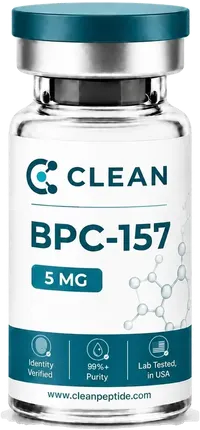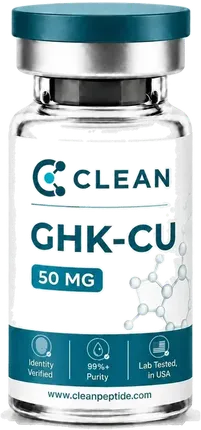
The GLOW peptide is a blend of three research peptides in one vial: GHK-Cu, BPC-157 and TB-500. “GLOW” is a seller’s name rather than a scientific one, the ratio of the three differs from shop to shop, and no published study has tested the three together. Each peptide does have its own research, summarised below.
Clean Peptide does not sell a GLOW blend. We sell KLOW, which contains all three GLOW peptides plus a fourth, KPV, and has each of the four measured on its certificate. The three GLOW peptides are also sold separately: GHK-Cu, BPC-157 and TB-500, plus the BPC-157 / TB-500 blend.
What is in a GLOW peptide blend?
| Peptide | What it is | Sequence | Molecular weight | CAS |
|---|---|---|---|---|
| GHK-Cu | Copper(II) complex of the plasma tripeptide Gly-His-Lys (copper tripeptide-1) |
GHK · Cu2+ |
401.91 g/mol |
89030-95-5 |
| BPC-157 | Synthetic 15-residue fragment of a gastric juice protein |
GEPPPGKPADDAGLV |
1419.5 g/mol |
137525-51-0 |
| TB-500 | N-acetylated fragment 17–23 of thymosin beta-4 |
Ac-LKKTETQ |
889.0 g/mol |
885340-08-9 |
Identity data: PubChem (CIDs 10111685, 9941957, 62707662) and the FDA substance registry. Sellers use different totals and ratios, so the label of a specific vial, and its certificate, are the only reliable guide to what is in it.
Where the name comes from
GLOW, KLOW and “Wolverine” are names from the research-chemical market. The pairing of BPC-157 and TB-500 is sold as the Wolverine stack; GLOW adds GHK-Cu, a copper peptide better known from cosmetic chemistry, and KLOW adds KPV to that. None of the three names appears in the scientific literature: a PubMed search for “GLOW”, “KLOW” or “Wolverine” with these peptides returns nothing.
GLOW vs KLOW
The only difference is KPV, the tripeptide Lys-Pro-Val from the end of alpha-MSH. KLOW has it; GLOW does not. Clean Peptide’s KLOW, analysed by HYTE Research Division (certificate CLP#00006), measured:
| GLOW | KLOW (Clean Peptide, measured) | |
|---|---|---|
| GHK-Cu | Yes |
54.90 mg |
| BPC-157 | Yes |
10.92 mg |
| TB-500 | Yes |
11.07 mg |
| KPV | No |
11.90 mg |
| Total | Varies by seller |
88.79 mg (label 80 mg), 99.97% HPLC purity |
The live certificate for the current KLOW lot:
| Laboratory | Analysed | HPLC purity | Measured content |
|---|---|---|---|
| HYTE Research Division | 17 Sep 2026 | 99.97% | 88.79mg |
Transcribed from the certificate issued for each size on sale today. Open the KLOW 80mg certificates
For a side-by-side page of the two blends, see KLOW vs GLOW.
What published research says about each GLOW peptide
None of the studies below tested a blend. Almost all are in cells or animals.
GHK-Cu
- Pickart reported the tripeptide in human plasma in 1973 and showed in 1980 that it binds copper(II) and increases copper uptake into cultured cells. Pickart L, et al. Nature, 1980.
- GHK-Cu stimulated collagen synthesis in fibroblast cultures and increased collagen and glycosaminoglycans in a rat wound-chamber model. Maquart FX, et al. FEBS Letters, 1988; Maquart FX, et al. Journal of Clinical Investigation, 1993.
- Randomised trials of topical GHK-Cu products are few and mixed. A 2026 evidence review concludes clinical evidence remains sparse. Mateescu DM, et al. Pharmaceutics, 2026.
BPC-157
- In rats with a transected Achilles tendon, BPC-157 groups had higher load to failure and stiffness than saline controls. Staresinic M, et al. Journal of Orthopaedic Research, 2003.
- It increased vessel formation in endothelial-cell and chick assays through VEGFR2 signalling. Hsieh MJ, et al. Journal of Molecular Medicine, 2017.
- A 2025 systematic review found 36 studies in musculoskeletal research, 35 of them preclinical. Vasireddi N, et al. HSS Journal, 2025.
TB-500
- TB-500 was identified analytically as Ac-LKKTETQ, the acetylated actin-binding fragment of thymosin beta-4. Esposito S, et al. Drug Testing and Analysis, 2012.
- The LKKTETQ motif matched full-length thymosin beta-4 in endothelial migration and sprouting assays. Philp D, et al. FASEB Journal, 2003.
- In a 2024 study, only one TB-500 metabolite, Ac-LKKTE, showed wound-healing activity in a fibroblast assay. Rahaman KA, et al. Journal of Chromatography B, 2024.
Has the GLOW combination been studied?
No. We found no study, in people or animals, that tests GHK-Cu, BPC-157 and TB-500 together. The only published work on any two of them together is a 2026 rat tendon study of BPC-157 with TB-500, in which the combination showed no additional benefit over either peptide alone. Biçer O, et al. Joint Diseases and Related Surgery, 2026.
Regulatory status
GLOW is not an approved product. BPC-157 and TB-500 were placed in FDA’s compounding safety-risk category in 2023 and are now listed there as nominated-but-withdrawn, as is injectable GHK-Cu. WADA’s 2026 Prohibited List names BPC-157 and TB-500. FDA compounding safety-risk list.
How to check a GLOW or KLOW vial
Because the name says nothing about the ratio, a blend is only as well defined as its certificate. Look for a certificate that lists each peptide separately with its measured quantity, not one total, plus an identity result for every component and an HPLC purity figure. Our guide to reading a peptide certificate of analysis goes through each line, and blends vs single peptides covers the trade-offs of buying a blend at all.