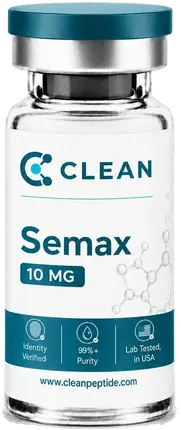
KLOW vs GLOW: What’s the Difference?
KLOW and GLOW are research-market names for multi-peptide blends. They share three peptides and differ by one.
GLOW is a blend of GHK-Cu, BPC-157 and TB-500.
KLOW is the same three plus KPV, the tripeptide Lys-Pro-Val from the end of alpha-MSH. The K is for KPV.
In short: KLOW = GLOW + KPV. Neither blend has been studied as a blend; each component has its own literature. Clean Peptide sells KLOW, with every component measured on its certificate, and does not sell GLOW.
KLOW vs GLOW at a Glance
Both are vendor blends, not single substances, so there is no formula or molecular weight for either. What defines a specific vial is its certificate: each component's identity and measured quantity, and the blend's HPLC purity.
| Comparison | KLOW | GLOW |
|---|---|---|
| Components | 4 peptides | 3 peptides |
| Label size | Blend (80 mg label) | Blend (varies by seller) |
| What is in it | GHK·Cu + KPV + Ac-LKKTETQ + GEPPPGKPADDAGLV | GHK·Cu + Ac-LKKTETQ + GEPPPGKPADDAGLV |
| Relationship | GLOW + KPV | KLOW without KPV |
| Research focus | Four-component blend research | Three-component blend research |
| Evidence | Components only; no study of the blend | Components only; no study of the blend |
| FDA-approved | No | No |
What are KLOW and GLOW
4 peptides
KLOW
GHK-Cu, KPV, TB-500 and BPC-157 in one vial. Our current lot measured 54.90 / 11.90 / 11.07 / 10.92 mg (88.79 mg total).
Component research areas
Copper peptide • Alpha-MSH tripeptide • Thymosin beta-4 fragment • Gastric pentadecapeptide
KPV is the alpha-MSH(11-13) tripeptide. In mouse studies its anti-inflammatory effect did not run through melanocortin receptors, and it entered intestinal cells through the PepT1 transporter.
Explore KLOW3 peptides
GLOW
GHK-Cu, BPC-157 and TB-500 in one vial. Totals and ratios differ between sellers.
Component research areas
Copper peptide • Thymosin beta-4 fragment • Gastric pentadecapeptide
No standard formula exists for GLOW. The only published study of any two GLOW peptides together, BPC-157 with TB-500 in rats, found no additional benefit over either alone.
Key Differences Between KLOW and GLOW
| Key differences | KLOW | GLOW |
|---|---|---|
| Components | GHK-Cu, KPV, TB-500, BPC-157. |
GHK-Cu, TB-500, BPC-157. |
| The extra peptide | KPV (Lys-Pro-Val), the C-terminal tripeptide of alpha-MSH, 342.43 g/mol. |
None. |
| Composition | Clean Peptide's current lot: GHK 54.90 mg, KPV 11.90 mg, TB-500 11.07 mg, BPC-157 10.92 mg (88.79 mg, label 80 mg). |
Varies by seller; no standard ratio. |
| Published evidence for the blend | None. Research exists for each component separately. |
None. Research exists for each component separately. |
| Clean Peptide | Sold, with a certificate measuring all four components and 99.97% HPLC purity. |
Not sold. The three GLOW peptides are sold individually. |
How the two blends are built
- KLOW
- GHK-Cu + BPC-157 + TB-500
- + KPV
- Four-component blend
- GLOW
- GHK-Cu + BPC-157 + TB-500
- No KPV
- Three-component blend
KLOW vs GLOW: Which Is Better?
Nobody can say from the evidence, because neither blend has been studied. The difference between them is whether KPV is in the vial.
If a research design needs KPV, KLOW includes it; if it must exclude KPV, GLOW, or the separate peptides, does that. For most designs, separate vials give the most control over what is being tested.
Does the design need KPV in the same vial as GHK-Cu, BPC-157 and TB-500, or each peptide on its own?
There Isn’t One Universal “Winner”
KLOW
Four-peptide blend
GHK-Cu • KPV • TB-500 • BPC-157
GLOW
Three-peptide blend
GHK-Cu • TB-500 • BPC-157
Compare the Research. Verify the Material.
A blend's name says nothing about its ratio, so the certificate matters more than for a single peptide. Look for each component identified and quantified separately, not one total figure.
Our KLOW certificate (HYTE Research Division, CLP#00006) identifies all four peptides by HPLC-DAD, measures each one, and reports endotoxin, sterility and heavy metals.
 Research use only
 Identity
verified Purity
verified Endotoxin
verified
 Research use only
- Identity
verified - Purity
verified - Endotoxin
verified
Question
Frequently Asked
What is the difference between KLOW and GLOW?
KLOW contains KPV; GLOW does not. Both contain GHK-Cu, BPC-157 and TB-500.
What does the K in KLOW stand for?
KPV, the tripeptide Lys-Pro-Val from the C-terminus of alpha-MSH.
Is KLOW stronger than GLOW?
There is no evidence either way. Neither blend has been studied; only the individual peptides have.
What ratio is in KLOW?
Ratios vary by seller. Clean Peptide's current KLOW lot measured GHK 54.90 mg, KPV 11.90 mg, TB-500 11.07 mg and BPC-157 10.92 mg.
Does Clean Peptide sell GLOW?
No. We sell KLOW and each GLOW peptide on its own: GHK-Cu, BPC-157 and TB-500.
What should a KLOW or GLOW certificate show?
Each peptide identified and quantified separately, an HPLC purity figure for the blend, and ideally endotoxin, sterility and heavy-metal results.
Research Peptides. Documented by Batch.
Every size in the catalogue ships against the certificate issued for its own lot.
For laboratory research use only. Not for human or veterinary use.
References
No published study tests GLOW or KLOW. The references below are for the individual peptides and for the one study of BPC-157 with TB-500.
- Biçer O, et al. Effects of BPC-157 and TB-500 on Achilles tendon healing in rats: A histopathological and biomechanical study Joint Diseases and Related Surgery, 2026. The only controlled study of two of these peptides together.
- Dalmasso G, et al. PepT1-mediated tripeptide KPV uptake reduces intestinal inflammation Gastroenterology, 2008.
- Getting SJ, et al. Dissection of the anti-inflammatory effect of the core and C-terminal (KPV) alpha-melanocyte-stimulating hormone peptides Journal of Pharmacology and Experimental Therapeutics, 2003.
- Maquart FX, et al. Stimulation of collagen synthesis in fibroblast cultures by the tripeptide-copper complex glycyl-L-histidyl-L-lysine-Cu2+ FEBS Letters, 1988.
- Esposito S, et al. Synthesis and characterization of the N-terminal acetylated 17-23 fragment of thymosin beta 4 identified in TB-500, a product suspected to possess doping potential Drug Testing and Analysis, 2012.
- Staresinic M, et al. Gastric pentadecapeptide BPC 157 accelerates healing of transected rat Achilles tendon and in vitro stimulates tendocytes growth Journal of Orthopaedic Research, 2003.