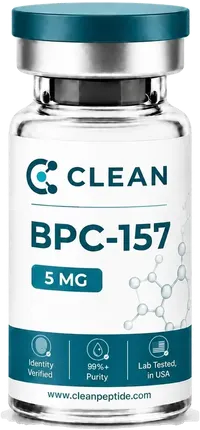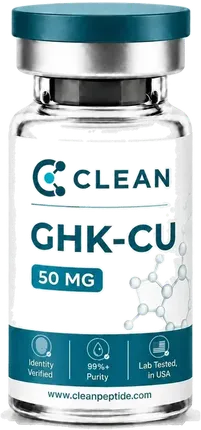
Clean Peptide’s KLOW certificate measures each of the four peptides separately. The certificate on file in October 2026 (HYTE Research Division, report CLP#00006, analysed 17 September 2026) measured GHK 54.90 mg, KPV 11.90 mg, TB-500 11.07 mg and BPC-157 10.92 mg in an 80 mg KLOW vial: 88.79 mg in total. It also reports 99.97% HPLC peak-area purity and confirms the identity of all four peptides by HPLC-DAD.
For a blend, that per-component breakdown matters more than the headline purity figure. This page sets out exactly what the certificate reports, what it does not, and how to check any KLOW or GLOW certificate in the same way.
Why a blend needs per-component results
A single-peptide certificate answers two questions: is it the right molecule, and how much of the sample is that molecule. A blend adds a third: how much of each peptide is in the vial. A blend certificate can show 99% purity and an 80 mg total and still tell you nothing about the ratio. One component could make up most of the mass and another almost none. “KLOW” and “GLOW” are market names, not formulas, and ratios differ between sellers. So the only way to know what a particular vial contains is a certificate that identifies and quantifies every component on its own line.
The KLOW certificate, line by line
Transcribed from HYTE Research Division report CLP#00006 (sample name “KLOW Blend – 80mg”, client Clean Peptide, cleanpeptide.com; received, analysed and published 17 September 2026):
| Sample | Test | Specification | Result | Status |
|---|---|---|---|---|
| GHK, KPV, TB-500, BPC-157 | Identity (HPLC-DAD) |
GHK, KPV, TB-500, BPC-157 |
All four peptides confirmed |
Pass |
| GHK, KPV, TB-500, BPC-157 | Purity (HPLC-DAD) |
> 99.0% |
99.97% |
Pass |
| GHK | Quantity (curve assay) |
80 mg blend total (NLT 90% of label claim) |
54.90 mg |
Pass |
| KPV | Quantity (curve assay) |
80 mg blend total (NLT 90% of label claim) |
11.90 mg |
Pass |
| TB-500 | Quantity (curve assay) |
80 mg blend total (NLT 90% of label claim) |
11.07 mg |
Pass |
| BPC-157 | Quantity (curve assay) |
80 mg blend total (NLT 90% of label claim) |
10.92 mg |
Pass |
| GHK, KPV, TB-500, BPC-157 | Endotoxins (LAL chromogenic) |
< 0.5 EU/mL |
< 0.5 EU/mL |
Pass |
| GHK, KPV, TB-500, BPC-157 | Sterility (pour plate) |
No growth |
No growth |
Pass |
| GHK, KPV, TB-500, BPC-157 | Heavy metals (chromogenic) |
Below reporting limit |
Not detected |
Pass |
The certificate’s summary boxes give a net quantity of 88.79 mg (blend total), 99.97% peak-area purity and an overall disposition of Pass. The certificate itself is on the KLOW 80mg product page under “Verified test results”: page 1 and page 2.
What is in the vial, by share of the measured total
Dividing each measured amount by the 88.79 mg total gives the composition of this lot:
| Component | What it is | Measured | Share of measured total |
|---|---|---|---|
| GHK-Cu (listed on the certificate as GHK) | Copper(II) complex of the tripeptide Gly-His-Lys |
54.90 mg |
about 62% |
| KPV | Alpha-MSH(11-13) tripeptide, Lys-Pro-Val |
11.90 mg |
about 13% |
| TB-500 | N-acetylated thymosin beta-4 fragment, Ac-LKKTETQ |
11.07 mg |
about 12% |
| BPC-157 | 15-residue peptide, GEPPPGKPADDAGLV |
10.92 mg |
about 12% |
| Total | 88.79 mg (label 80 mg) |
100% |
What this certificate does not show
- No lot number. The certificate’s lot number and lot code fields are blank (“-“). It is identified by its report number, CLP#00006, and the product page shows it as the certificate for the KLOW on sale. Because it has no lot number, it does not appear in the lot-by-lot certificate library.
- No per-component label claim. Each quantity is tested against the 80 mg blend total (not less than 90% of label claim), not against a stated target for that component. The certificate tells you what was measured, not what ratio was intended.
- The total is above the label. 88.79 mg measured against an 80 mg label is about 111% of label claim.
- Endotoxin as a limit, not a value. It is reported as below 0.5 EU/mL, not as a measured number.
The certificate on file today
The table below is read from the same certificate records as the product page, so it updates when the KLOW certificate changes. If it shows a newer certificate than CLP#00006, the newer one is the one that applies.
| Laboratory | Analysed | HPLC purity | Measured content |
|---|---|---|---|
| HYTE Research Division | 17 Sep 2026 | 99.97% | 88.79mg |
Transcribed from the certificate issued for each size on sale today. Open the KLOW 80mg certificates
KLOW vs GLOW: composition
KLOW is GLOW plus KPV. Both names describe vendor blends rather than defined substances, so the certificate is what defines a particular vial.
| Component | GLOW | KLOW | Clean Peptide KLOW, measured (CLP#00006) |
|---|---|---|---|
| GHK-Cu | Yes |
Yes |
54.90 mg |
| BPC-157 | Yes |
Yes |
10.92 mg |
| TB-500 | Yes |
Yes |
11.07 mg |
| KPV | No |
Yes |
11.90 mg |
| Ratio | Varies by seller |
Varies by seller |
About 62 : 13 : 12 : 12 (GHK : KPV : TB-500 : BPC-157) |
Clean Peptide sells KLOW and does not sell GLOW. For more on the two blends, see KLOW vs GLOW and the GLOW peptide blend. No published study has tested either combination as a blend; research exists on each component separately.
How to check any KLOW or GLOW certificate
- Every component is named in the identity result, not just “blend confirmed”.
- Every component has its own quantity in mg, so you can work out the ratio yourself.
- The quantities add up to a total you can compare with the label.
- The method is stated for identity, purity and quantity.
- The laboratory, client and dates are on the certificate, and the certificate is tied to the vial by a lot number or report number.
- You can check the report with the laboratory. Our guide to verifying a peptide COA shows how.
A blend certificate that gives only one purity figure and one total weight does not tell you what is in the vial.